

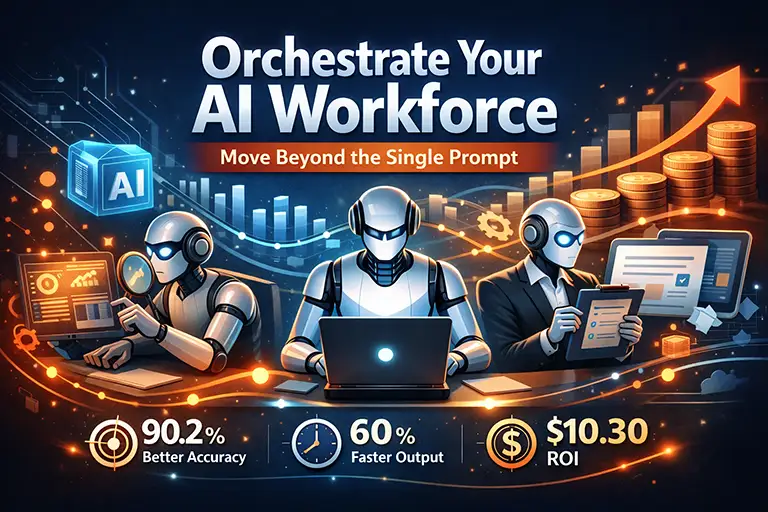
You’ve likely felt the “prompting plateau.” You send a complex brief to an AI, and the output comes back generic, cluttered, or slightly off-track. This happens because a single, monolithic agent struggles when you overload it with goals, context, and constraints all at once. Instead of trying to make one prompt do everything, you get far better results by orchestrating a system of coordinated AI agents. These agents work like a high-performance team.
Shift from Tools to Teams
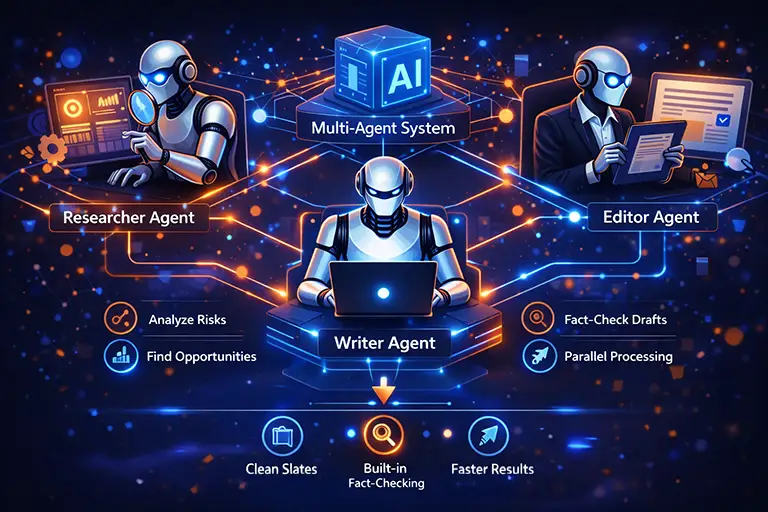
Most people still treat AI as a one-off text generator: you drop in a giant prompt and hope for magic. A better approach is to think in terms of teams, not tools. In a multi-agent setup, specialized agents like a Researcher, Strategist, Writer, and Editor collaborate through structured hand-offs. Rather than passing messy prose, these agents exchange clean data objects such as bulleted research briefs or JSON summaries, so the Writer is focused on narrative execution instead of wading through raw notes.
In advanced multi-agent research systems, a coordinating “lead” model delegates to role-specific sub-agents, then aggregates their outputs into a coherent result. This kind of orchestration can significantly outperform single-model setups on complex research and reasoning tasks when evaluated on internal benchmarks.
Why Modularity Wins: Curing “Context Rot”
When you pour everything into one prompt, you create noise. Long-context windows often suffer from what can be called Context Rot (or “signal degradation”). This is where the AI begins to over-prioritize its own earlier sentences and intermediate outputs over your original instructions. Modularity fixes this through a separation of concerns: each agent sees only what it needs to do its job well.
- Clean Slates: Each agent gets a narrowly scoped job and a tight instruction set. A Researcher agent does not need your entire 50-page style guide; it only needs data parameters and evaluation criteria. Keeping contexts lean and role-specific helps keep the model “fresh” and can reduce hallucinations by anchoring each step to the most relevant information.
- Built-in Review: You can define a Critic agent whose sole logic gate is to audit outputs. It compares the Writer’s draft against the Strategist’s goals and key constraints, and if it detects a mismatch, it triggers an automatic revision loop before the content ever reaches your desk.
- Parallel Speed (The Fan-Out): You can use fan-out patterns to run divergent tasks simultaneously. While a human must work serially, your AI system can analyze multiple audience segments or angles at the same time, then merge the insights into a master strategy in minutes instead of hours. In practice, multi-agent setups with parallel calls have delivered very large reductions in research time on complex, breadth-first tasks.
The Financial Case for Agentic Workflows
Moving to an orchestrated workflow is an ROI decision. Using integrated AI in end-to-end processes rather than used as a one-off toy, the economics change in your favor.
- Compound Returns: Independent industry analyses show that organizations implementing generative AI at scale often realize several dollars of value for every dollar invested, while “frontier” or “top leader” firms that embed AI deeply into core workflows report returns as high as around $10.30 per $1. These firms are not just using AI for ad hoc copy, but for systematized, cross-functional workflows.
- Efficiency Gains: In marketing and content operations, surveys and case studies frequently report double-digit reductions in production and campaign costs once repeatable AI workflows (like automated asset repurposing and standardized drafting) are in place. You are not just saving time; you are actively lowering the marginal cost of intelligence and experimentation across channels.
Top “frontier” companies that operationalize AI across processes have been observed to generate up to roughly three times the value of slower adopters, underscoring the advantage of deep, workflow-level integration rather than isolated pilots.
Your New Operating Model: The 70/30 Rule
You do not need to automate everything to win. A sustainable strategy lets AI handle the toil while you retain the judgment. Think in terms of the 70/30 Rule: AI agents handle roughly 70% of the mechanical execution, and you focus on the most valuable 30%.
You operate as the Architect. First define the system topology. You choose the roles (Researcher, Strategist, Writer, Editor, Critic), encode the brand guardrails, and specify where human review is mandatory. The agents execute the heavy lifting through research, first drafts, variant generation, and repurposing. Humans step in for high-leverage interventions like sharpening the unique point of view, aligning with campaign strategy, or making the final call on what ships. This keeps quality and brand integrity high while still letting you scale far beyond a human-only team.
Performance at a Glance
| Your Goal | Agentic Impact | Technical Advantage |
| Increase Accuracy | Up to 90% better performance on complex research tasks in multi-agent evaluations, compared to a single general-purpose agent baseline in internal tests. | Uses Critic Loops and dedicated review agents to catch hallucinations early and enforce alignment with goals. |
| Save Time | Up to 60% faster turnaround on research and content workflows in many reported AI-assisted marketing and content operations. | Uses fan-out patterns and parallel tool calls so multiple agents can process tasks concurrently instead of serially. |
| Boost Revenue | Top “frontier” firms report returns of around $10.30 for every $1 invested in generative AI initiatives when AI is deeply integrated into core workflows. | Deep integration creates a competitive moat of always-on, AI-accelerated content and decision-making. |
| Cut Costs | Many organizations see 20–30%+ reductions in campaign and production costs once standardized AI workflows are in place. | Automates the toil of research, repurposing, revision, and formatting, and reduces back-and-forth cycles. |
When you stop treating AI as a one-off prompt and start orchestrating it as a modular workforce, you trade incremental gains for compounding ones. Better accuracy, faster cycles, and stronger economics, all without sacrificing the human judgment that makes your brand credible.